Ser vs Estar: A Simple Chart, Rules and Examples
Both mean 'to be' in Spanish. Here is a plain-English guide to when to use ser and when to use estar, with a memory trick, a chart and examples.
Spanish has two verbs that both mean “to be”: ser and estar. English only has one, which is why this trips up almost every beginner. The good news is that the rules are simpler than they look, and a small memory trick covers most cases.
The one-line version
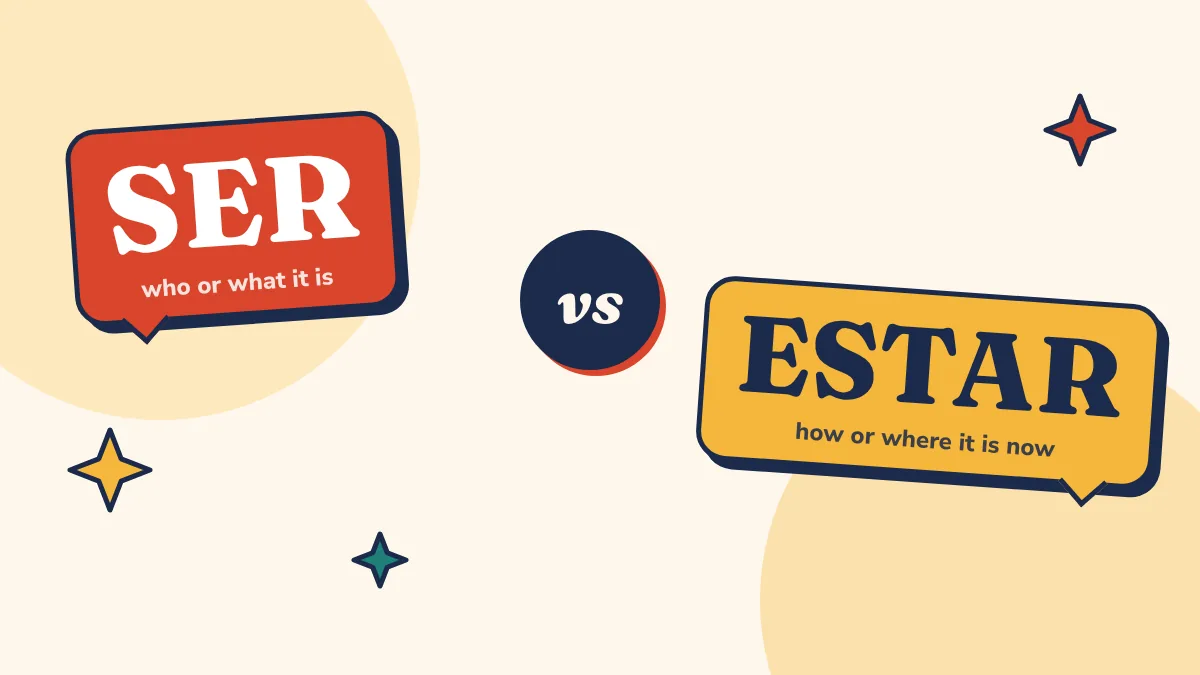
- Ser says what something is: who you are, what you do, where you are from, what you are like.
- Estar says how or where something is right now: your mood, your condition, your location.
Conjugation chart (present tense)
| Person | Ser | Estar |
|---|---|---|
| yo (I) | soy | estoy |
| tú (you) | eres | estás |
| él / ella / usted (he / she / you formal) | es | está |
| nosotros (we) | somos | estamos |
| vosotros (you all, Spain) | sois | estáis |
| ellos / ellas / ustedes (they / you all) | son | están |
The memory trick: DOCTOR and PLACE
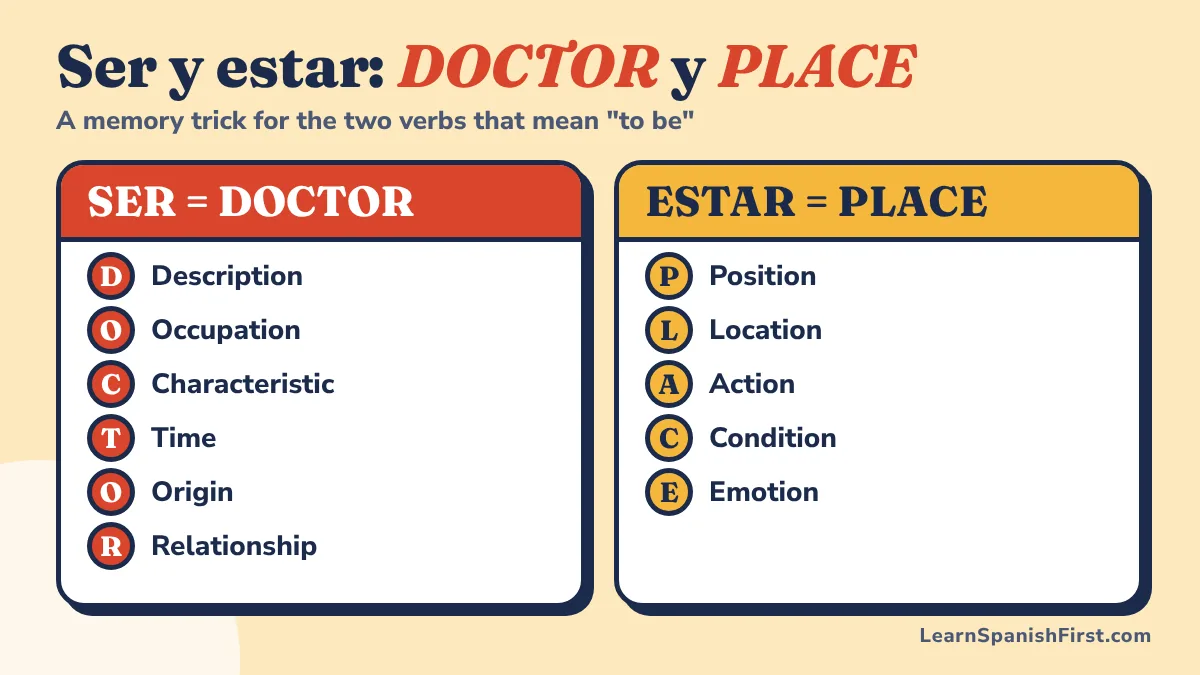
Use ser for DOCTOR:
| Letter | Use | Example |
|---|---|---|
| Description | What something is like | Mi casa es grande. (My house is big.) |
| Occupation | Jobs | Ella es doctora. (She is a doctor.) |
| Characteristic | Traits and personality | Soy tímido. (I am shy.) |
| Time | Dates, days and hours | Son las tres. (It is three o’clock.) |
| Origin | Where you are from | Somos de México. (We are from Mexico.) |
| Relationship | Who is who to you | Él es mi hermano. (He is my brother.) |
Use estar for PLACE:
| Letter | Use | Example |
|---|---|---|
| Position | How something is positioned | El libro está abierto. (The book is open.) |
| Location | Where something is | Estoy en casa. (I am at home.) |
| Action | Actions happening now | Estoy comiendo. (I am eating.) |
| Condition | Temporary state | El café está frío. (The coffee is cold.) |
| Emotion | How you feel | Estamos felices. (We are happy.) |
Same adjective, different meaning
Some adjectives change meaning depending on the verb. These are worth memorizing.
| Adjective | With ser | With estar |
|---|---|---|
| aburrido | boring (Es aburrido.) | bored (Está aburrido.) |
| listo | clever (Es lista.) | ready (Está lista.) |
| malo | bad (Es malo.) | sick or off (Está malo.) |
| rico | rich (Es rico.) | tasty (Está rico.) |
| verde | green (Es verde.) | unripe (Está verde.) |
| seguro | safe (Es seguro.) | sure (Está seguro.) |
Two common exceptions
- Events use ser for location. La fiesta es en mi casa. (The party is at my house.) The party is an event, not an object sitting somewhere.
- Some fixed phrases use estar. Estoy de acuerdo. (I agree.) Estoy bien. (I am fine.) Learn these as chunks.
Quick practice
Pick ser or estar:
- Mi madre ___ enfermera. (es, occupation)
- Nosotros ___ cansados. (estamos, condition)
- ¿De dónde ___ tú? (eres, origin)
- El baño ___ al fondo. (está, location)
- Hoy ___ lunes. (es, day)
Tips for beginners
- Do not wait until you have mastered this to start speaking. Native speakers will understand you even when you mix them up.
- Start with the phrases you will use most: Soy…, Estoy…, ¿Cómo estás?, ¿De dónde eres?
- Say example sentences out loud, because the right verb will start to sound correct.
For more on the verbs you will use every day, see our guide to common Spanish verbs. If you are brand new, our 3-month Spanish plan shows where ser and estar fit in.
Questions
Is ser or estar for permanent things?
Ser is for what something is: identity, origin, occupation and lasting traits. Estar is for how something is right now: location, mood and condition. 'Permanent vs temporary' is a useful shortcut but it has exceptions.
How do I remember ser vs estar?
Use DOCTOR for ser (Description, Occupation, Characteristic, Time, Origin, Relationship) and PLACE for estar (Position, Location, Action, Condition, Emotion).
Do you use ser or estar for location?
Use estar for where a person or thing is: 'Estoy en casa.' The exception is events, which use ser: 'La fiesta es en mi casa.'
Why does 'estoy de acuerdo' use estar?
Some fixed phrases just use estar. 'Estoy de acuerdo' means 'I agree.' Learn these as chunks instead of trying to work them out.
Ready to go beyond cheat sheets?
Lists get you started. To actually speak, you need audio, repetition and a clear order to learn things. Our recommended course covers all three.
Affiliate link. We may earn a commission at no extra cost to you. Disclosure.
Get the free Spanish Starter Pack
Printable cheat sheets in one bundle, sent to your inbox.
Free, no spam. Unsubscribe any time.